If payments are made in accordance with section 28 of the Construction Act, those payments may be considered to reduce the security posted to vacate a lien. Using section 28 to make direct payments to subcontracts, including for holdback, may be an effective way to flow funds that are owing and reduce security posted for a lien.
Adjudications are seeing more use as a quick and efficient dispute resolution tool for Ontario-based construction projects. The fundamental components of adjudication are established in the Construction Act, but savvy industry participants should be aware of the impact construction contracts can (and cannot) have on adjudications.1
Construction projects often generate excess soil and with that comes a statutory regime that needs to be complied with to avoid liability. Despite these laws coming into legal force and effect in phases over the last four years, there is still a lot of confusion about Ontario’s excess soil laws.
2708320 Ontario Ltd. cob Viceroy Homes v Jia Development Inc.,1 provides helpful guidance on the interpretation of frivolous, vexatious and abusive liens under the Construction Act. It also examines the cost implications for stakeholders in construction lien proceedings who register liens that are baseless or grossly excessive.2
Issued a statement of claim? Served the claim in accordance with the Rules? No defence delivered within the time limit and now you want to move to note the defendants in default and obtain default judgment? Not so fast! In Akhtar v. Taha Development, 2024 ONSC 746, the court outlines the various factors it considers when deciding whether to grant default judgment against defendants who have been noted in default.
If you receive a Notice of Non-Payment (form 1.1)1 from the owner, you are being notified that the owner will not pay you for some or all of your proper invoice. You then have a short window of time to take action.
The Construction Act (formerly the Construction Lien Act) is part of the daily reality for many who work in Ontario’s construction industry. The Act is important legislation because it governs payments, holdbacks, liens, substantial performance, adjudications, trusts, and more.
In their podcast, #Lawntreprenuers Faren Bogach and Dan Fridmar talk about building the brands of Construct Legal (Canada) and Fridmar Professional Corporation. They talk about names, brand, logo and so much more.
On January 15, 2024, the City of Greater Sudbury (“Sudbury”) filed a lawsuit against two unknown persons and several Canadian banks to freeze and recover $1.5 million stolen during a December 21, 2023 spear phishing scam. The incident arose from an invoice payment to new general contractor Flex Modular of the Lorraine Street Transitional Housing project that is delivering 40 units of affordable housing in Sudbury.
Courts are delayed. The health of the economy is uncertain. Companies are looking for options to get paid quickly. Some of those options might be arbitration and adjudication.
Ledore Investments v. Dixin Construction1 is the first decision where an adjudication determination was set aside and remitted back to the adjudicator. The Divisional Court found that the parties did not have an opportunity to make submissions on the determinative issue, resulting in a breach of procedural fairness.
If you work as a contractor or subcontractor on a construction project involving the federal government of Canada, you should know that the new Federal Prompt Payment for Construction Work Act (the “Act”) may apply to you. The Act recently came into force on December 9, 2023 and offers prompt payment timelines and an adjudication procedure that previously did not exist at the federal level.
Two years ago today, Construct Legal officially opened! Things are a little different two years later as we have grown to a team of 7 legal professionals.
Construct Legal is excited to announce our webinar Jack of All Trades: Are Owners Responsible for Safety for Everyone and Everything on a Project? on Friday, January 19, 2024 at 10:00 AM EST.
Faren Bogach (LLB’07) is founder and lawyer at Construct Legal in Toronto. She started as a commercial litigator before finding construction and infrastructure law. “I founded Construct Legal to focus on client outcomes instead of the billable hour,” she says.
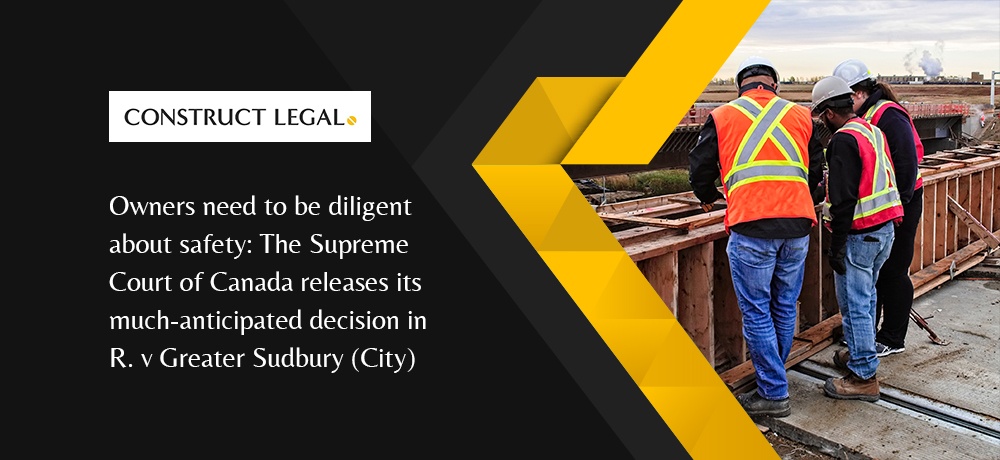
An owner may have the responsibilities (and corresponding liabilities in the event of an accident) of an “employer” under Ontario’s Occupational Health and Safety Act (“OHSA”), even when the owner has retained a contractor to perform the actual work. This can be true even where the owner does not have direct control of the work, but this element of control may be relevant to the owner’s “due diligence” to argue that it took all reasonable steps in the circumstances.
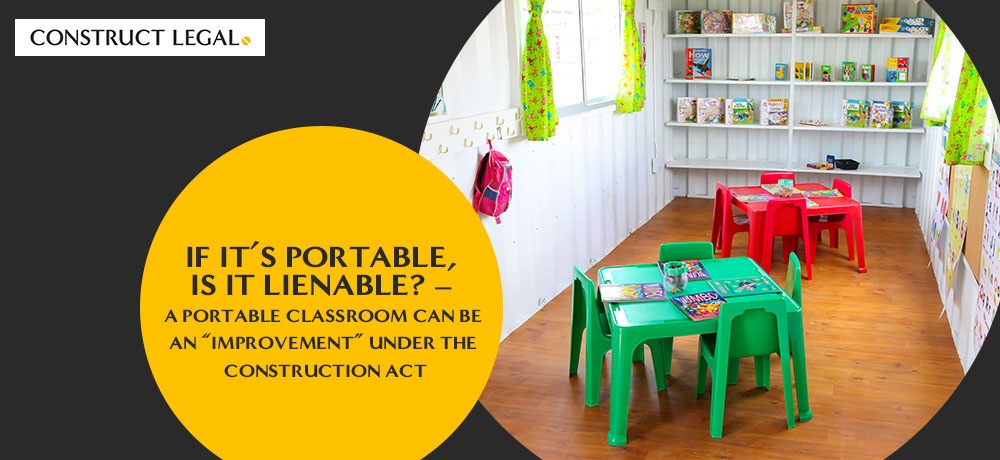
In the recent decision of On Point Ltd. v Conseil des Écoles Catholiques du Centre Est et al., the Ontario Superior Court of Justice held that portable school classrooms (or “portables”) can constitute improvements within the meaning of the Construction Act.